Absorbing Boundary Cells
Where the lattice meets the edge of its domain, the outermost cell does not fit. The rule is that it takes up the remainder: its outer side is constrained to the boundary line, and the parallelogram becomes a trapezoid with a longer base.
import itacart
from itacart import boundary
cell = "SE(1930/0196)"
(boundary.cell_shape(cell), boundary.absorbs_border(cell),
 itacart.is_equal_area_cell(cell))
('trapezoid', True, False)
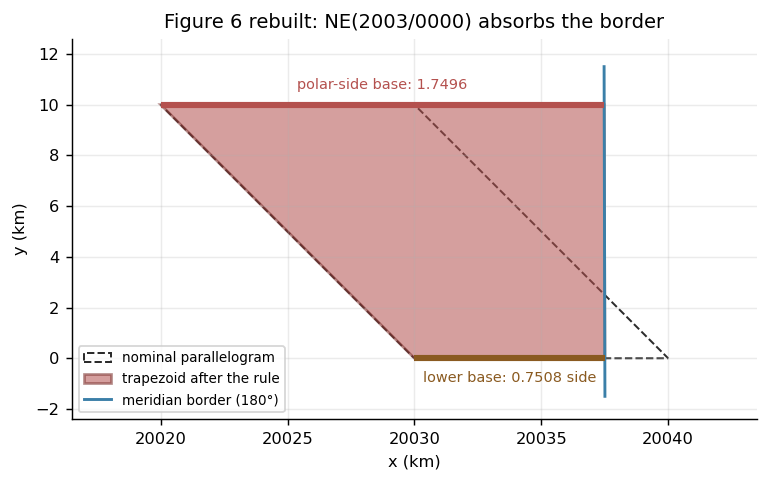
docs/_static/f4/f4_08_trapezoid_absorption.png
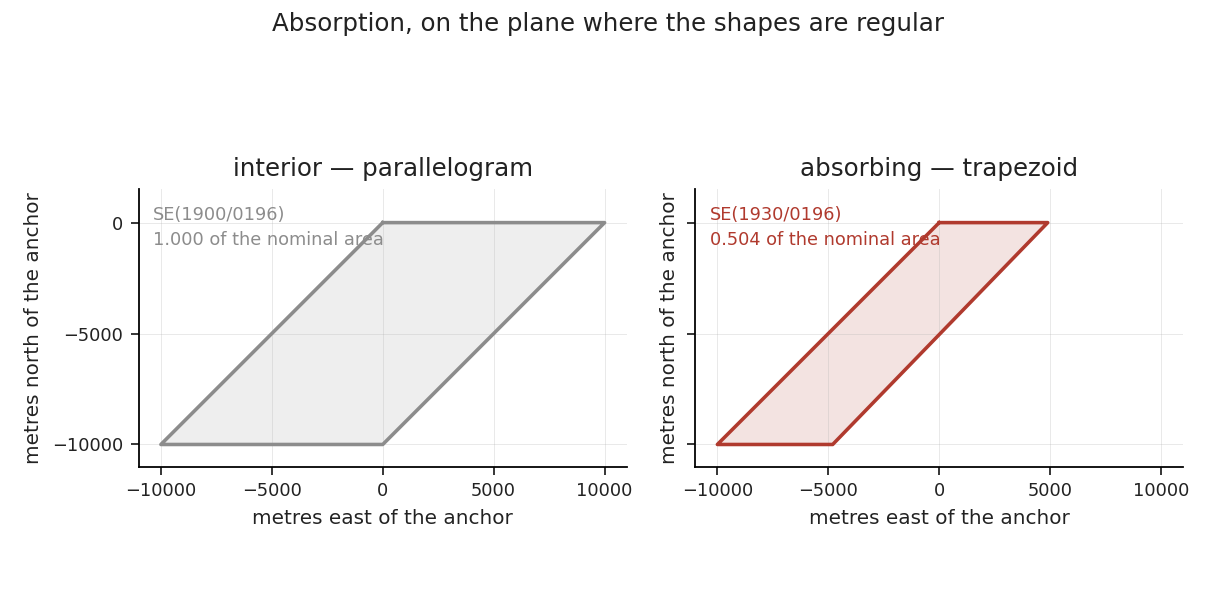
The same row, the same nominal area, drawn on the sinusoidal plane where the
shapes are regular. docs/_static/f9/f9_22_absorbing_cell_against_interior.png
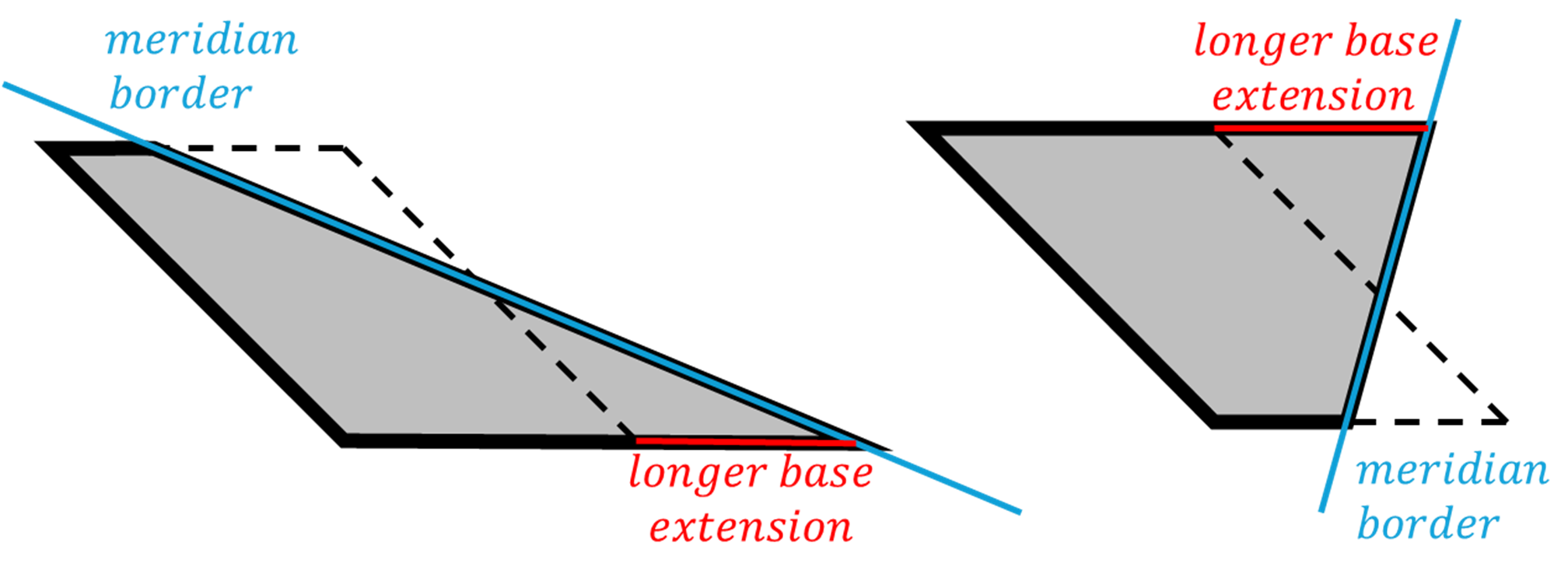
Figure 6 of the paper: the trapezoidal cells the rule produces.
docs/_static/fpaper/fpaper_06_trapezoidal_cells.png
The rule is stated narrowly in the specification: it applies when a vertex of the parallelogram on the side opposite the prime meridian exceeds the boundary, and it applies to that cell only, not to all subsequent resolutions.
They do not carry the nominal area
This is the one family that breaks the equal-area guarantee, and it is the reason the guarantee is stated conditionally everywhere else:
round(itacart.effective_cell_area(cell)), round(itacart.nominal_cell_area(1))
(50436935, 100000000)
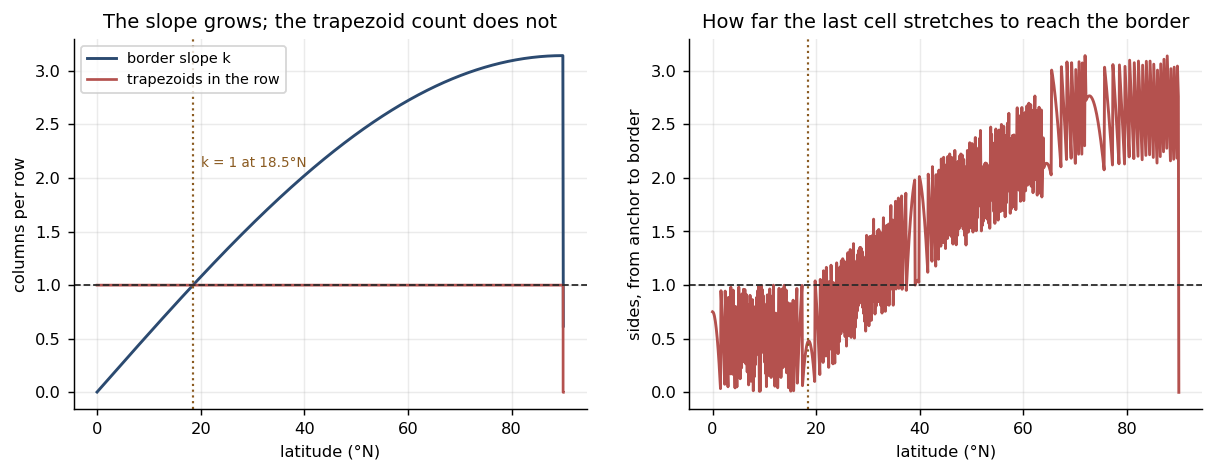
About half. Not a rounding error — half a cell, which in cadastral terms is fifty square kilometres at resolution 1.
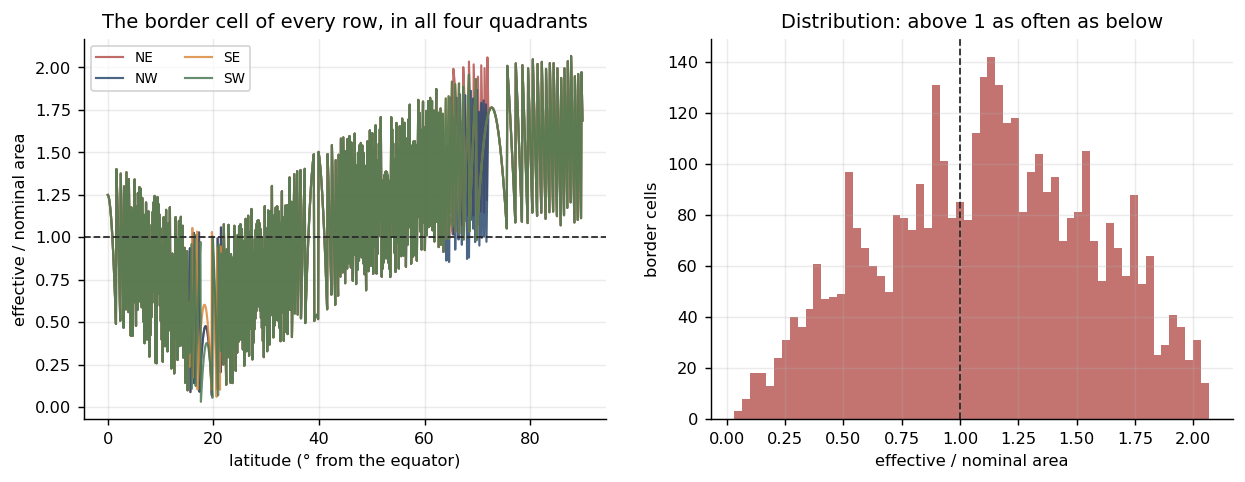
docs/_static/f4/f4_17_trapezoid_areas.png
docs/_static/f4/f4_09_absorption_across_latitude.png
The guard is never the shape name. Ask the construction: Effective vs Nominal Geometry.
Where the edge is
The lattice narrows towards the poles, so the last existing column is a function of the row:
[(row, boundary.last_lattice_column("SE", row, 10000.0))
 for row in (0, 196, 500, 900, 999)]
[(0, 2003), (196, 1930), (500, 1414), (900, 311), (999, 1)]
Two thousand and three columns at the equator, one at the last row. That narrowing is what Polar Caps is about.
The trapezoid is not inherited
A meridian triangle refines into triangles. An absorbing trapezoid does not refine into trapezoids, and its children do not number the refinement ratio:
len(list(itacart.get_children(cell, flatten=True)))
3
Three where the rule says four, because the border truncates the parent’s own footprint. A cell that absorbs has been measured to hold between two and six children, which is why the package enumerates children rather than multiplying.
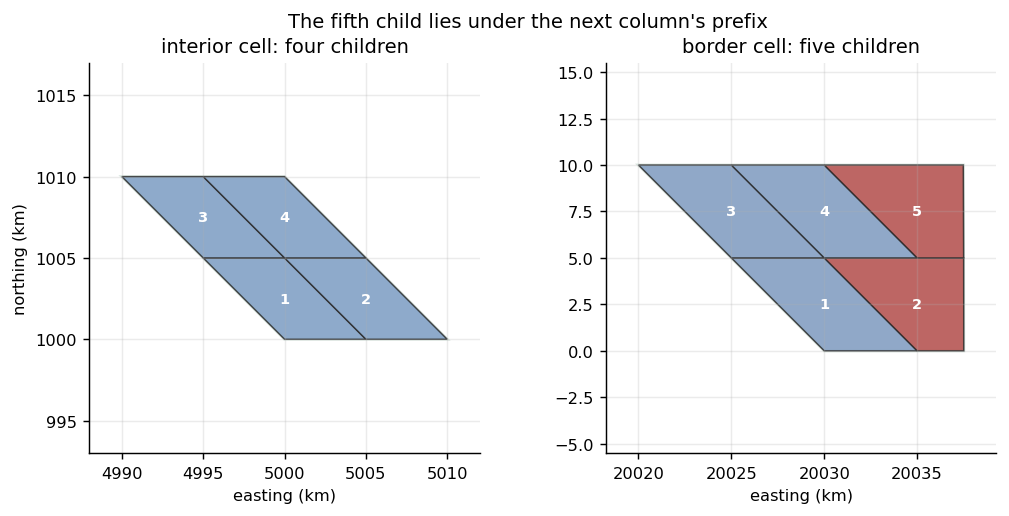
docs/_static/f5/f5_07_trapezoid_children.png
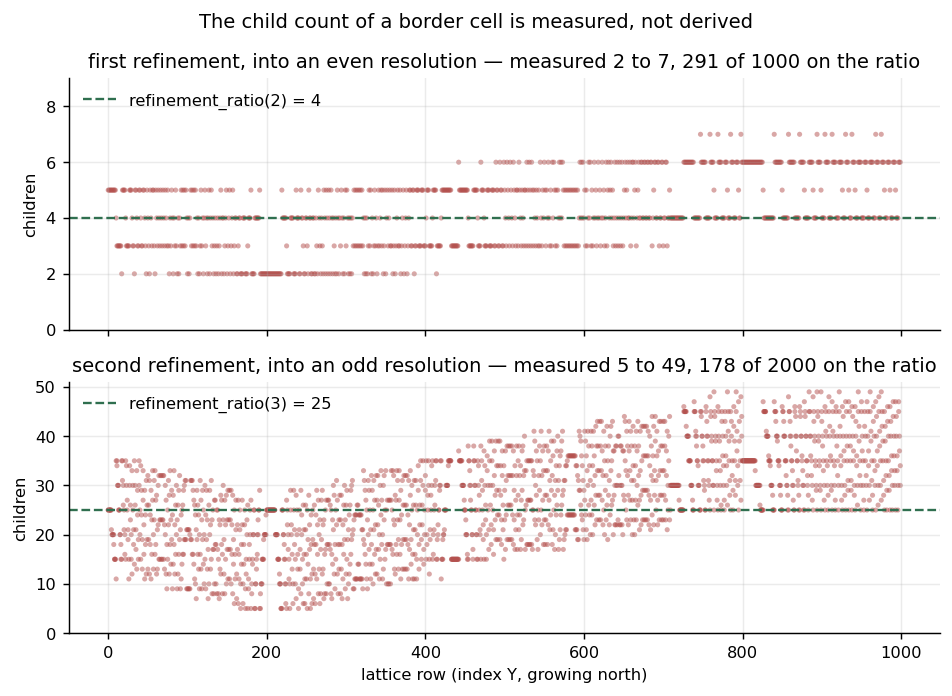
docs/_static/f5/f5_06_border_children_counts.png
Children reach past their parent
The border is a smooth convex curve, and an absorbing cell replaces its outer side by the chord of that curve across its own height. A parent spans one cell height and takes one chord; each child spans half that height and takes two — and a chord over a shorter span lies further out.
So a child of an absorbing cell lies partly outside its parent’s effective ring, by construction. This is a declared limitation of this version rather than a defect awaiting repair, and it is stated in full, with its measurements, at Lexical Ancestry vs Physical Refinement.
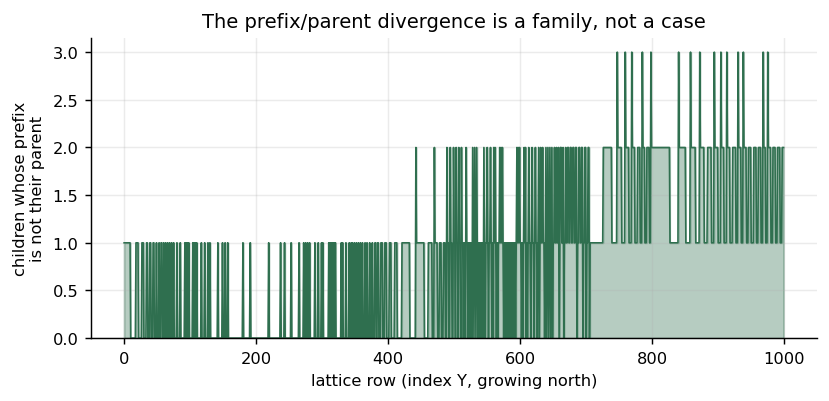
docs/_static/f5/f5_03_parent_prefix_divergence.png
Working near the border
Test is_equal_area_cell before any area arithmetic. Enumerate children rather
than assuming a count. Expect grid distances to stop behaving like a square
lattice — Grid Distance says why. And
do not reingest an exported border outline as fresh geographic geometry:
Geographic vs Grid Geometry
measures what that costs.