Cell Validity & Existence
Three things can be true of an index string, and they are not the same thing. It can parse. It can be valid. And the cell it names can exist. A string can pass the first two and fail the third.
from itacart import index as ix
ix.is_valid_index("XX(abc)")
False
Not a quadrant code, so it does not parse.
ix.is_valid_index("NE(0001/0002(A1))")
False
This one parses. It fails anyway, because resolution 2 is an even level and
wants a digit from 1 to 4; A1 belongs to the odd alphabet. Validity is
about whether every code is legal for its own level.
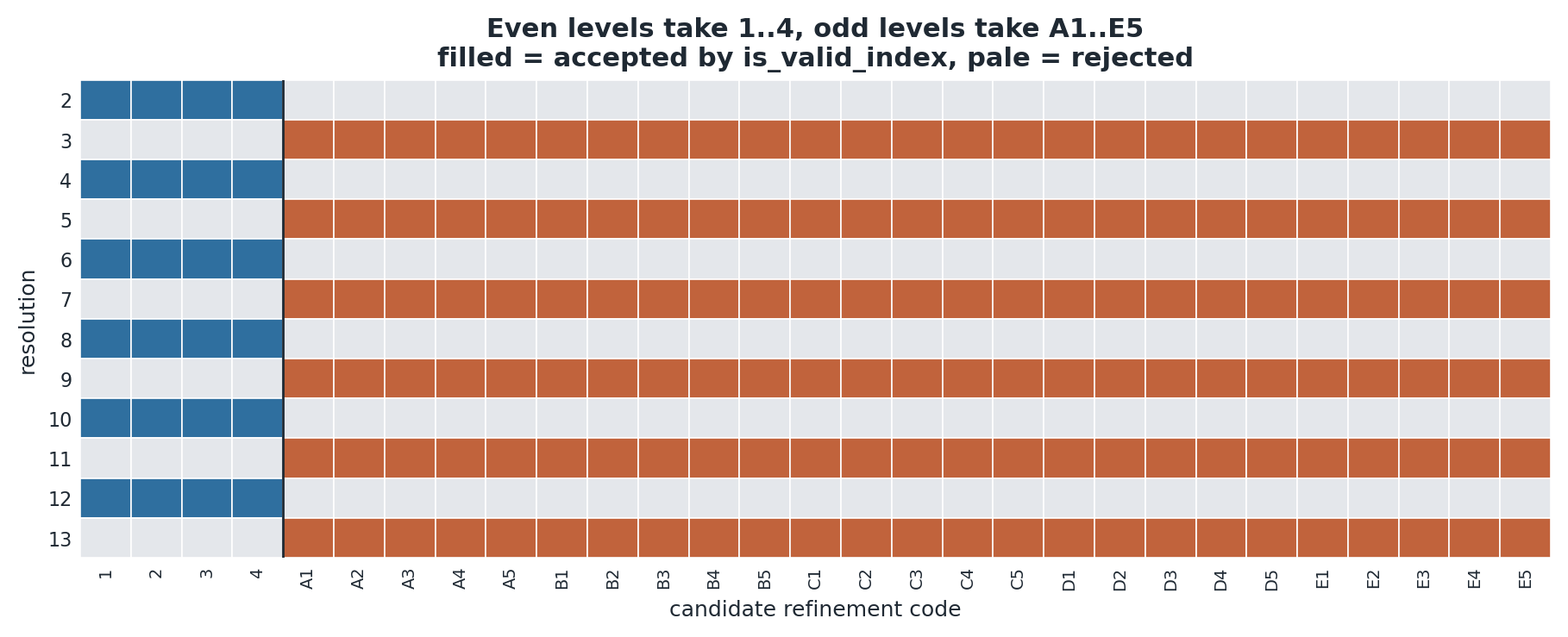
docs/_static/f2/f2_03_alphabet_acceptance.png
Valid and still nonexistent
ix.is_valid_index("NW(0000/0500)")
True
Valid. Every component is legal, the quadrant is real, the coordinates are in range. But the cell is not there:
import itacart
from itacart.exceptions import NonExistentCellError
try:
    itacart.cell_to_centroid("NW(0000/0500)")
except NonExistentCellError as exc:
    print(exc)
index names no cell: NW(0000/0500)
The reason is in the specification rather than in the implementation. Cells straddling the prime meridian are isosceles triangles, mirrored across the meridian, and they are indexed in the eastern quadrants only — the western quadrants have no meridian column, because it would name the same ground twice. So at resolution 1 a western cell with an X index of zero is structurally nonexistent. Meridian and Equator is where that geometry is worked out.
Why the package refuses rather than repairs
A nonexistent cell could be silently mapped to its eastern twin. The package raises instead, and the choice is deliberate: an address that names no cell is almost always a bug upstream — an arithmetic slip in a traversal, a coordinate that escaped its domain, a record built by hand. Answering it plausibly hides the fault and propagates it into stored data.
The same reasoning governs the rest of the error surface. Every exception the package raises descends from one root, so a pipeline can guard itself without catching stray failures from elsewhere:
from itacart.exceptions import ITACaRTError
issubclass(NonExistentCellError, ITACaRTError)
True
The distinctions that matter most
InvalidIndexError — the string is malformed. InvalidRefinementCodeError — a
code is from the wrong alphabet for its level. NonExistentCellError — the
address is well formed and names nothing. DomainError — coordinates or a cell
fall outside the addressable domain altogether. MaxResolutionError and
MinResolutionError — an attempt to refine past 13 or ascend above 0.
Catching the root is right for a pipeline boundary. Catching a specific one is
right where you can actually do something different — retrying a traversal at
a boundary, say, rather than aborting it. The full hierarchy is in
itacart.exceptions.