Conformance Status
Which requirements are met, which are not, and how each claim is checked.
import itacart
report = itacart.conformance()
report["summary"]
{'conformant': 19,
 'non_conformant': 5,
 'core_conformant': True,
 'eaers_conformant': False,
 'coverage': {'full': 19, 'partial': 4, 'none': 1}}
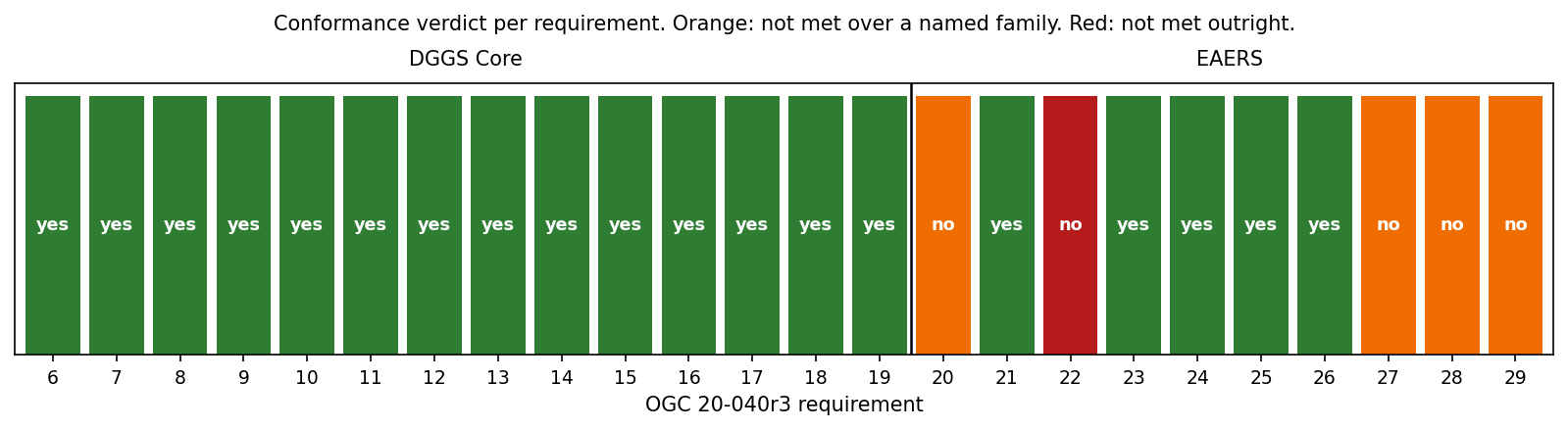
Twenty-four requirements. Nineteen met in full, four partially, one not at all. Core conformant; EAERS not.
docs/_static/f9/f9_17_conformance_board.png
The five divergences
[(r["requirement"], r["coverage"]) for r in report["requirements"]
 if r["coverage"] != "full"]
[('20', 'partial'),
 ('22', 'none'),
 ('27', 'partial'),
 ('28', 'partial'),
 ('29', 'partial')]
Each carries its own justification, and the justifications are the substance:
import textwrap
for r in report["requirements"]:
    if r["coverage"] != "full":
        print(f"--- requirement {r['requirement']} ({r['coverage']}) ---")
        print(textwrap.fill(r["justification"], 76))
        print()
--- requirement 20 (partial) ---
The data models of Figures 20 and 22 are satisfied. Figure 21 is not: it
describes a polyhedral interface, and ITACaRT tessellates the ellipsoid
directly, so there is nothing for that interface to describe. Two models out
of three, which a shall does not accept.

--- requirement 22 (none) ---
No base unit polyhedron is mapped to the surface. The initial tessellation
is direct on the ellipsoid, which is the design choice the paper makes for
absolute geodetic fidelity, and it is a property of the reference system
rather than a gap.

--- requirement 27 (partial) ---
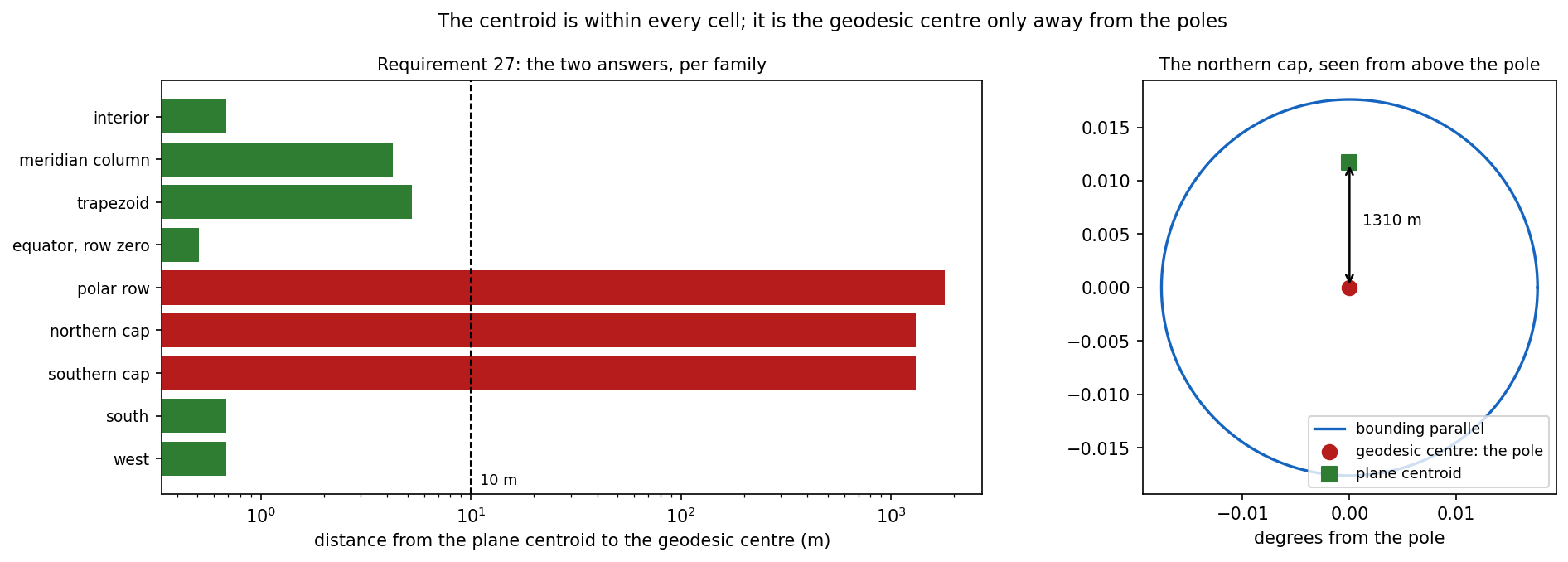
cell_to_centroid is the direct position, it lies on the surface, and it is
within the cell everywhere. Over the ordinary families it agrees with the
geodesic centre of surface area to within ten metres, which on a cell 10 km
across is a thousandth of the cell; over the parallelogram families the
agreement is 0.7 m and stable under refinement of the search. It is
nonetheless the area centroid of the equal-area projection plane inverted to
geodetic, and the requirement names the geodesic centre. The two part
company at the polar row and the two caps, where the cap's geodesic centre
is the pole itself and the plane answer sits about 1.3 km short of it: three
orders of magnitude, and three families out of ten. A shall is not met by
seven.

--- requirement 28 (partial) ---
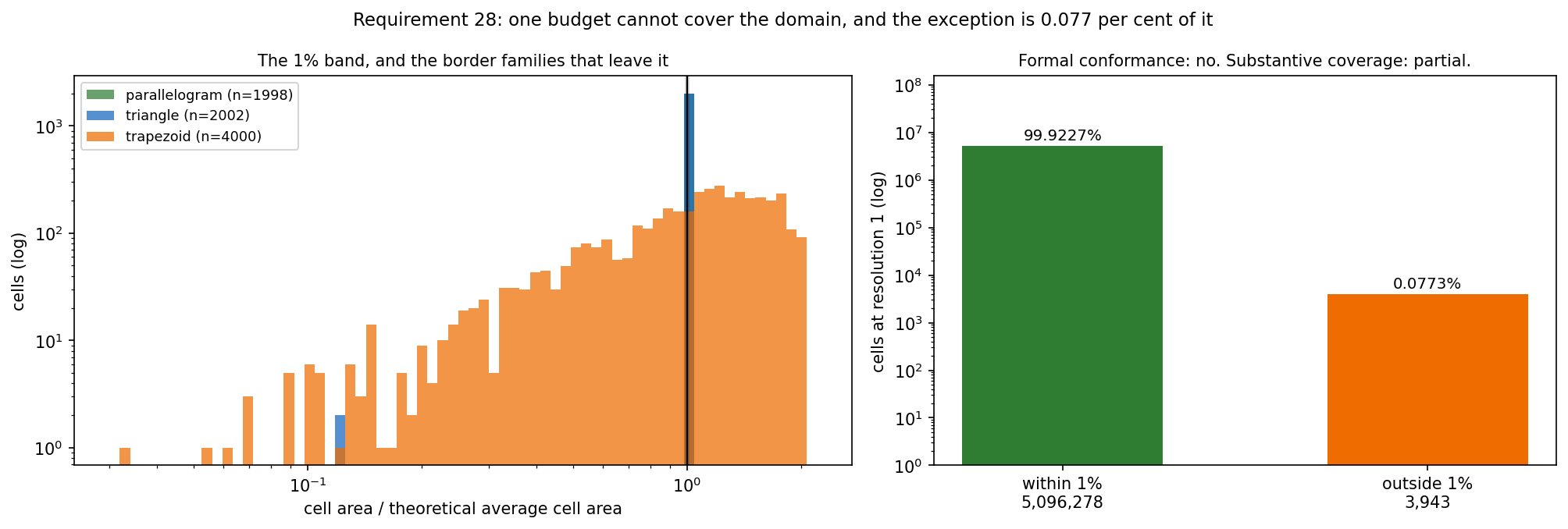
The requirement fixes a budget of 1 per cent or less against the theoretical
average cell area, which at resolution 1 is 100 008 533 m squared over 5 100
221 cells. Formal conformance is no, because a budget covering the whole
domain cannot be stated. Substantive coverage is partial, and the exception
is small and named: 3941 antemeridian trapezoids and the 2 polar caps, 3943
cells or 0.077 per cent of the grid. Every other cell, parallelogram and
meridian triangle alike, sits at 0.999915 of the theoretical average, which
is 0.0085 per cent off and well inside the budget. The trapezoid family runs
from 0.032 to 2.067 and the caps sit at 0.121; those figures describe that
family, not the grid.

--- requirement 29 (partial) ---
The projection is equal-area by construction, so every ordinary cell of a
resolution has the same area as every other, measured uniformly at 0.999915
of the theoretical average. The requirement is per cell geometry, and the
trapezoid geometry is not internally equal-area: clipping on the
antemeridian leaves a family running from 0.032 to 2.067. The polar caps
carry the same failure into the triangle geometry, at 0.121 against the
meridian triangles' 0.999915.
Formally non-conformant, substantively close
Requirement 28 is the clearest case of the distinction the overview draws. The budget is one per cent or less against the theoretical average cell area — at resolution 1 that average is 100 008 533 square metres over 5 100 221 cells.
Formal conformance is no, because a budget covering the whole domain cannot be stated. Substantive coverage is partial, and the exception is small and named: 3 941 antemeridian trapezoids and the 2 polar caps, which is 3 943 cells or 0.077 per cent of the grid.
Every other cell — parallelogram and meridian triangle alike — sits at 0.999915 of the theoretical average, which is 0.0085 per cent off and well inside the budget. The trapezoid family runs from 0.032 to 2.067 and the caps sit at 0.121; those figures describe that family, not the grid.
docs/_static/f9/f9_20_equal_area_budget.png
Requirement 27 is the same shape of argument. cell_to_centroid lies on the
surface and within the cell everywhere. Over the ordinary families it agrees
with the geodesic centre of surface area to within ten metres — on a cell ten
kilometres across, a thousandth of the cell — and over the parallelogram
families to 0.7 metres, stable under refinement of the search. It is
nonetheless the area centroid of the equal-area projection plane inverted to
geodetic, and the requirement names the geodesic centre. The two part company
at the polar row and the two caps, where the cap’s geodesic centre is the pole
itself and the plane answer sits about 1.3 kilometres short: three orders of
magnitude, in three families out of ten.
A shall is not met by seven. That sentence is the whole reason these are reported as non-conformant rather than as rounding.
docs/_static/f9/f9_18_centroid_against_geodesic_centre.png
How the claims are checked
The table above is generated, not written. itacart.conformance() reads the
package’s own record, and a conformance test suite exercises the requirements
in continuous integration — so a claim that stops being true fails a build
rather than surviving in a document.
That is also why this page shows the report instead of restating it. There is one copy of the conformance position, and you are reading it.
Reading the numbering
The requirement numbers here are the standard’s, as the implementation records them, and they do not line up item for item with the table printed in the paper. Where the two differ, this report is the one that is checked.