Neighbors & Grid Traversal
Adjacency is computed from the index, not from coordinates. That is a requirement the standard makes of a discrete global grid, and it is what keeps traversal cheap.
import itacart
from itacart import topology
cell = itacart.geo_to_cell(-46.6328862, -23.5508962, resolution=9)
north = topology.get_neighbor(cell, "N")
north
'SW(0476/0260(4(A2(4(A4(1(E5(4(C4)))))))))'
Directions are lattice compass codes — N, S, E, W and the four
diagonals. Two cells are neighbours when they share an edge:
topology.are_neighbor_cells(cell, north)
True
How the arithmetic works
The rule depends on which kind of level you are on, and all three cases are arithmetic on the string.
At resolutions 0 and 1 the step is integer arithmetic on the
XXXX/YYYY pair: the Y index decreases for the cell above and increases for
the cell below, the X index decreases to the west and increases to the east.
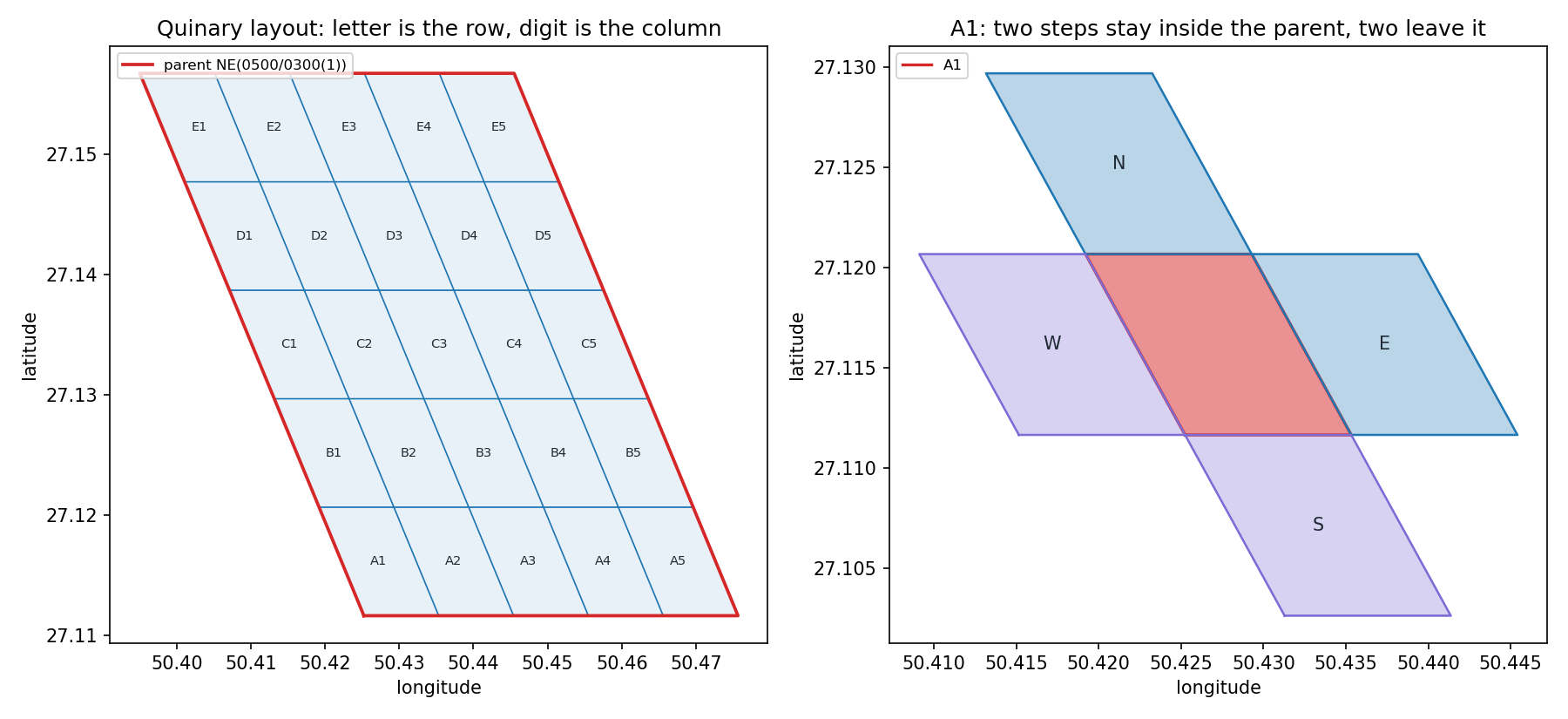
At even resolutions the four children sit in a two-by-two block. Vertical adjacency adds or subtracts two; horizontal adjacency adds or subtracts one.
At odd resolutions the twenty-five children sit in a five-by-five block.
The numeric part of the code moves horizontally — C2 to C3 — wrapping
between columns 5 and 1; the alphabetic part moves vertically — C2 to B2 —
wrapping between rows E and A.
docs/_static/f6/f6_02_refinement_grids.png
Crossing into another parent
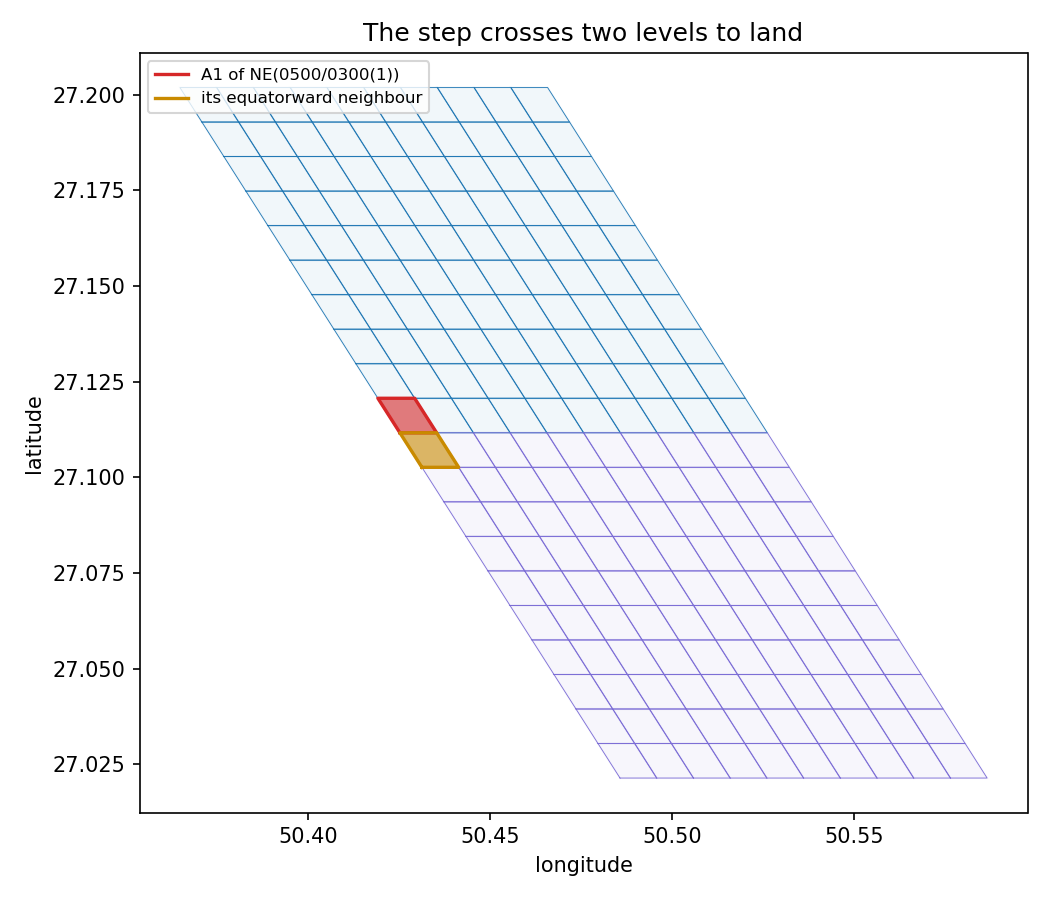
When the neighbour is not a sibling, the wrap-around has carried you out of the parent block. The procedure is to ascend, step at the parent’s level, and descend into the corresponding child:
docs/_static/f6/f6_03_ascend_and_descend.png
That is why the wrap is safe rather than wrong: a code that wraps is the signal to go up a level, not an answer in itself.
When the step falls off the lattice
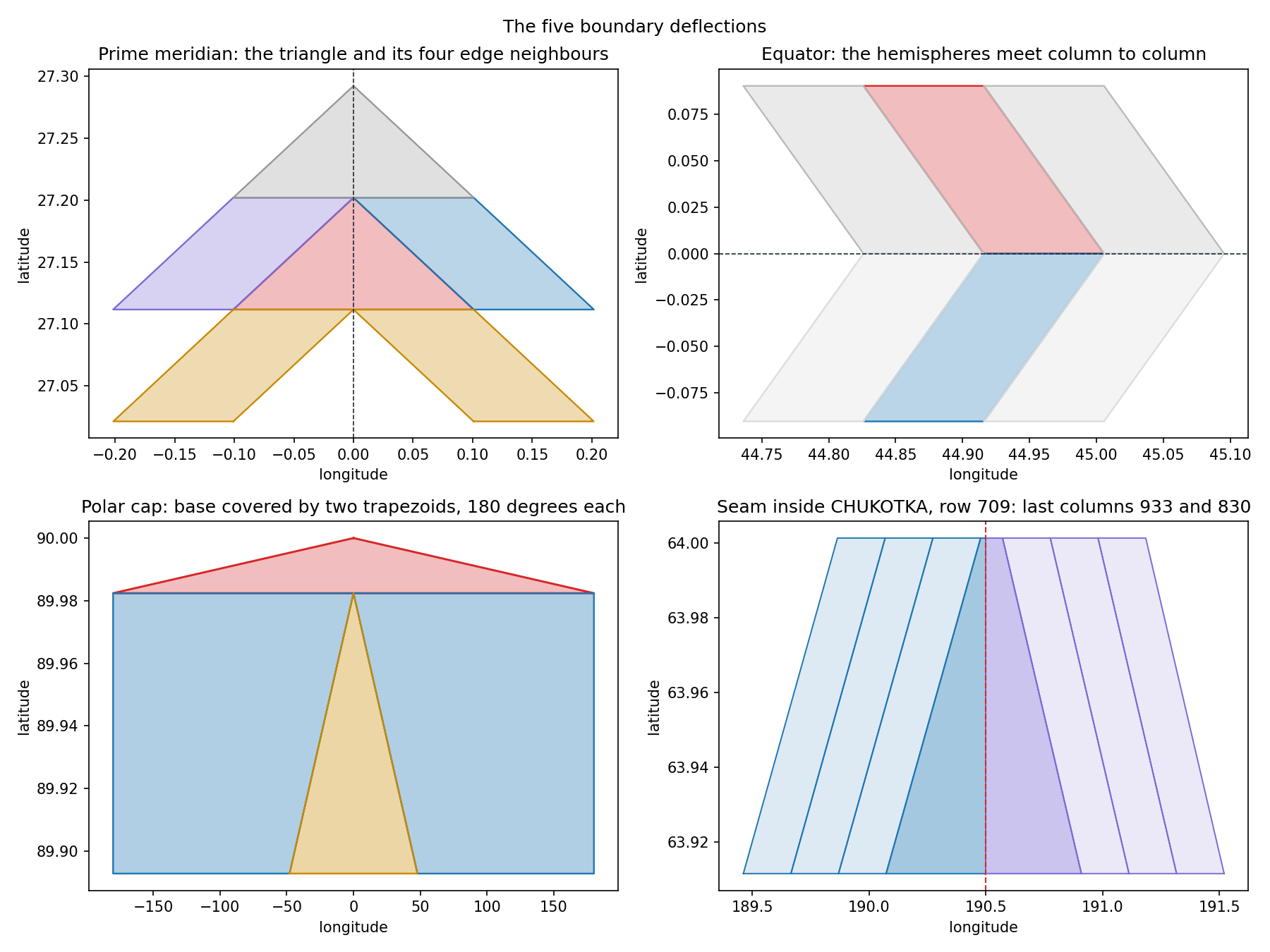
At a quadrant edge or the domain border, the lexical target of a step can name
no cell. deflect resolves those:
from itacart.exceptions import ITACaRTError
try:
    print(topology.deflect("NE(0000/0500)", "W"))
except ITACaRTError as exc:
    print(type(exc).__name__, "--", exc)
NW(0001/0500)
docs/_static/f6/f6_04_boundary_deflections.png
Because the quadrants mirror one another, ITACaRT never uses negative indices — a step that would go negative deflects into the neighbouring quadrant instead. Meridian and Equator works through the geometry behind those deflections.
Rings and disks
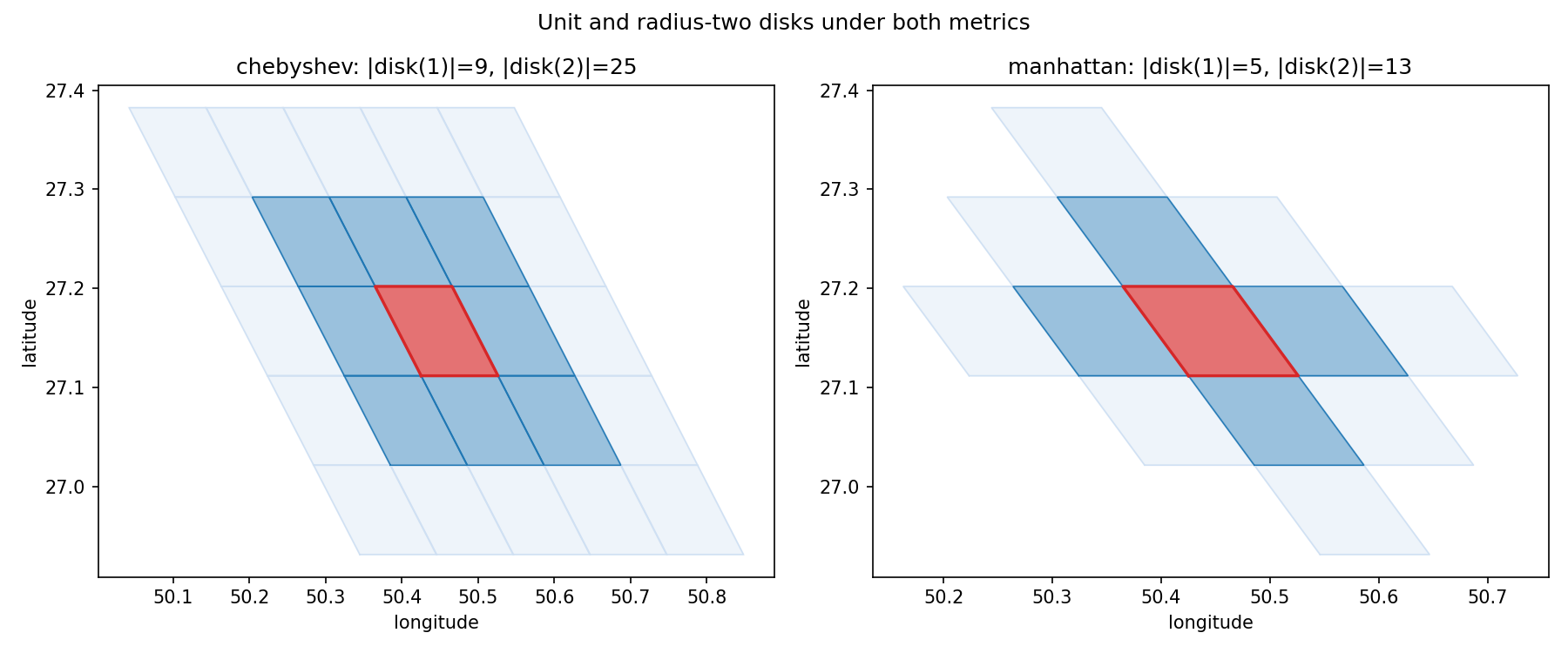
A disk is every cell within k steps, the origin included; a ring is the
hollow shell at exactly k.
[(k, len(topology.grid_disk(cell, k)), len(topology.grid_ring(cell, k)))
 for k in (1, 2, 3)]
[(1, 9, 8), (2, 25, 16), (3, 49, 24)]
docs/_static/f6/f6_06_disk_cardinality.png
The counts follow from the metric. Under the default chebyshev diagonal steps
count as one, so the unit disk is a filled rhombus of nine cells. Under
manhattan only axis steps are allowed and the unit disk is a diamond of five:
(len(topology.grid_disk(cell, 1)),
 len(topology.grid_disk(cell, 1, metric="manhattan")))
(9, 5)
Near a boundary the counts fall below these figures, because some of the shell
names no cell. Do not compute a disk’s size from k — ask for the disk.
Edges as first-class objects
A step can be named rather than taken:
edge = topology.cells_to_directed_edge(cell, north)
topology.directed_edge_to_cells(edge) == (cell, north)
True
The identifier is the two cells and a direction, and it round-trips. Every edge leaving a cell is available at once:
len(topology.cell_to_edges(cell))
4