Meridian and Equator
The prime meridian and the equator divide the globe into the four quadrants, and each quadrant’s lattice is a mirror of the others. That symmetry is why ITACaRT never uses a negative index — but it leaves a seam down the middle.
The problem the mirror creates
Applying the same parallelogram geometry to each quadrant produces discontinuities along the quadrant’s own meridian. The cells on either side do not meet: reflected across the meridian, the lean of one is the mirror of the other, and the two leave a gap that neither fills.
The triangle
The solution keeps the area and changes the shape. A cell straddling the prime meridian is an isosceles triangle whose base is twice its height, with the cell’s index sitting at the midpoint of the base. The figure is therefore mirrored across the meridian, and it tiles the gap exactly.
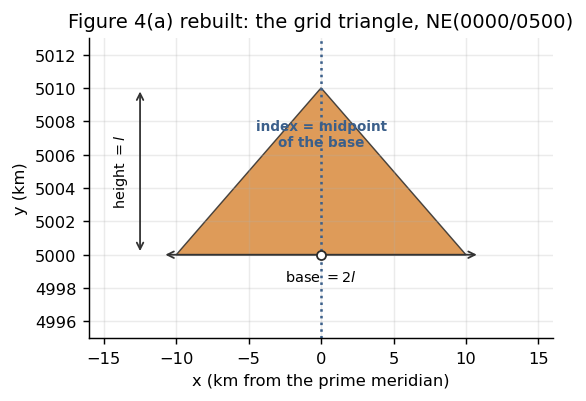
docs/_static/f4/f4_01_grid_triangle.png
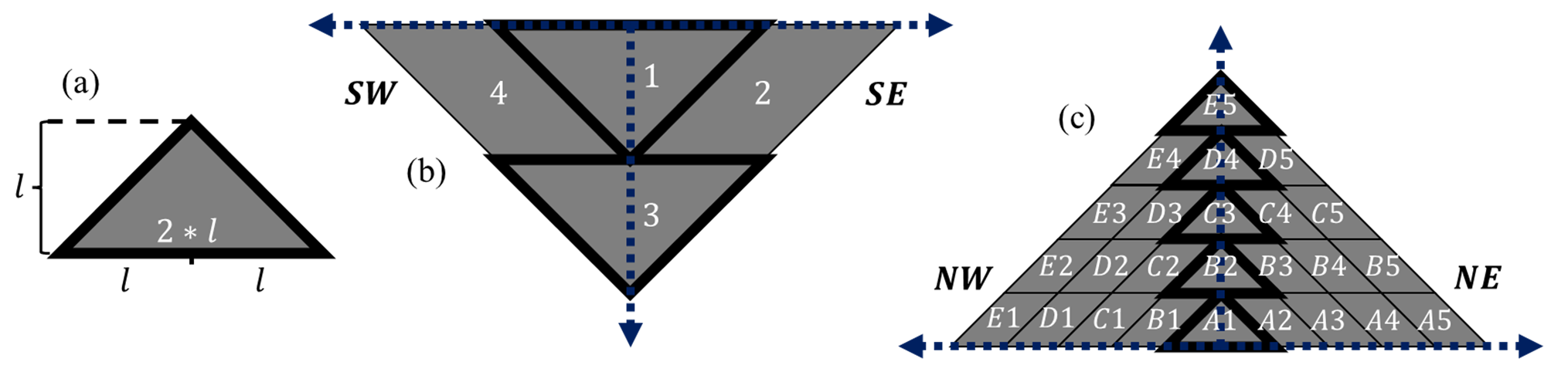
Figure 4 of the paper: the triangle, and how it refines on each side of
the meridian.
docs/_static/fpaper/fpaper_04_grid_triangle_and_prime_meridian.png
A triangle keeps the base-and-height behaviour of a parallelogram, so the area survives the change of shape:
import itacart
from itacart import boundary
tri = "NE(0000/0500)"
boundary.cell_shape(tri), itacart.is_equal_area_cell(tri)
('triangle', True)
Equal-area, like any interior cell. The vertex count is what differs:
len(itacart.cell_to_boundary(tri, close=True))
4
Four positions — three distinct vertices plus the closing repeat.
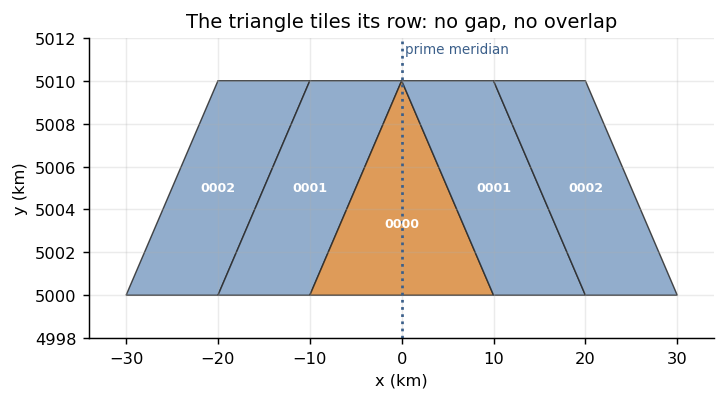
docs/_static/f4/f4_02_triangle_tiles_its_row.png
Indexed once, in the east
The triangle spans both sides of the meridian, so indexing it in both quadrants would name the same ground twice. It is indexed in the eastern quadrants only. At resolution 1 and coarser, the western quadrants simply have no meridian column:
from itacart import index as ix
from itacart.exceptions import NonExistentCellError
ix.is_valid_index("NW(0000/0500)")
True
Valid, and nonexistent:
try:
    itacart.cell_to_centroid("NW(0000/0500)")
except NonExistentCellError as exc:
    print(exc)
index names no cell: NW(0000/0500)
That is the case Cell Validity & Existence is built around, and this is where it comes from.
The triangle is inherited
At finer resolutions the indexing does not create separate western cells along this boundary either — they are part of the hierarchical subdivision of the adjacent eastern cells. A meridian triangle therefore refines into triangles, all the way down:
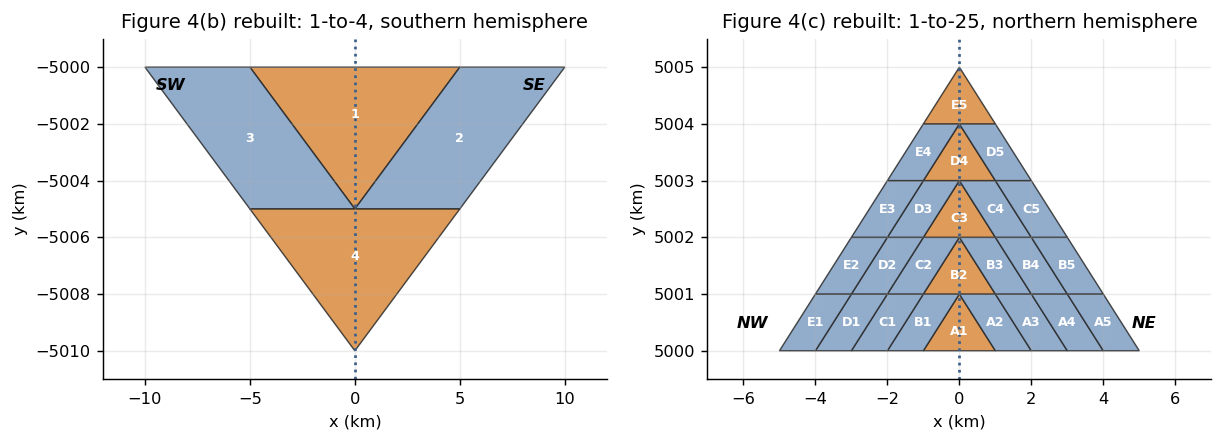
docs/_static/f4/f4_03_triangle_refinement.png
This is the opposite of what happens at the outer edge, where the trapezoid is not inherited — Absorbing Boundary Cells is the contrast.
The equator
The equator divides north from south and needs no special cell. Rows are counted outward from it in each quadrant, so row 0 sits against the equator and the row index grows towards the pole. The mirror across the equator is exact, which is why a northern cell and its southern twin share a base angle:
from itacart import metrics
metrics.cell_base_angle("NE(1400/0374)"), metrics.cell_base_angle("SE(1400/0374)")
(115.11878283907643, 115.1187828390764)
Stepping across a seam
A step whose lexical target falls outside its quadrant’s range does not fail — it deflects into the neighbouring quadrant:
from itacart import topology
topology.deflect("NE(0000/0500)", "W")
'NW(0001/0500)'
Neighbors & Grid Traversal covers when a traversal needs this and when the ordinary arithmetic suffices.