Index Structure
An index is a string, and the string is the address at every resolution at once. Reading one left to right is descending the hierarchy.
from itacart import index as ix
ix.split_components("SE(1400/0374(3(C2(3))))")
['SE', '1400/0374', '3', 'C2', '3']
Five components, one per level.
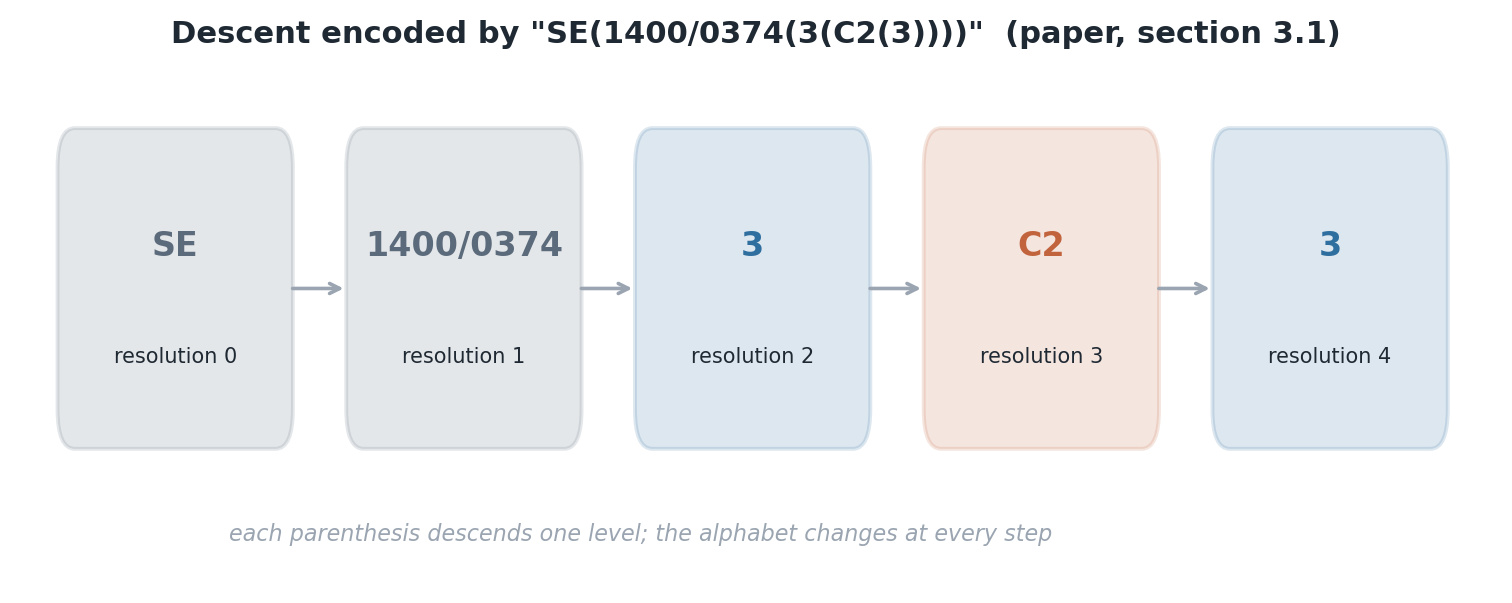
docs/_static/f2/f2_04_index_anatomy.png
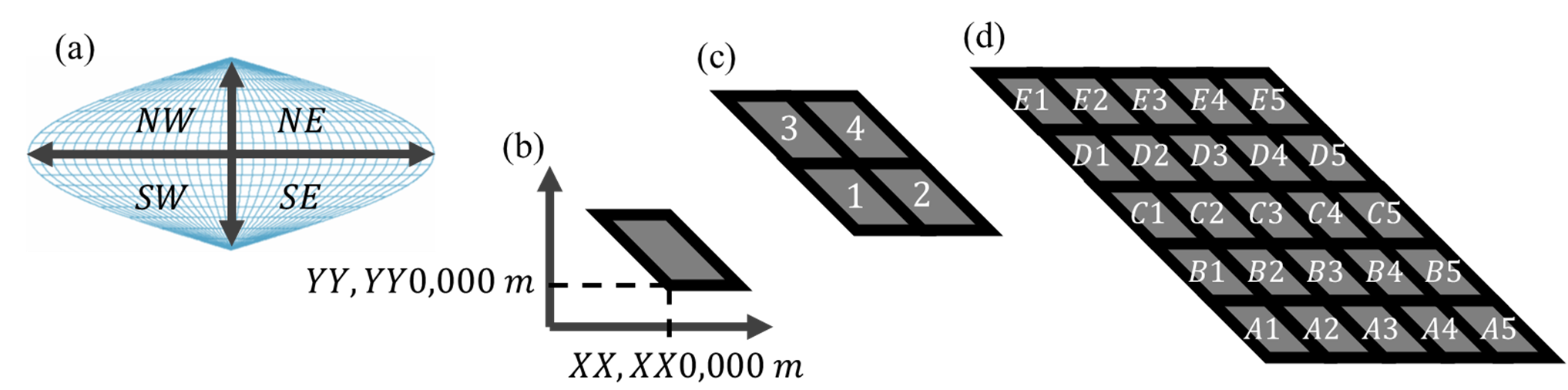
Figure 3 of the paper: the four kinds of component, in order —
quadrant, Cartesian pair, the digits 1 to 4, and the A1–E5 alphabet.
docs/_static/fpaper/fpaper_03_indexing_by_resolution.png
The four kinds of component
The quadrant, a two-letter code: NE, NW, SE, SW. The globe is
divided by the prime meridian and the equator, and this is resolution 0.
The base cell, a pair of integers XXXX/YYYY relative to the quadrant’s
origin. This is resolution 1, the ten-kilometre level, and it is addressed by
Cartesian coordinates in the projection — which is the point. A surveyor
reading 1400/0374 is reading a column and a row.
On the WGS84 ellipsoid a quadrant holds roughly two thousand base cells along the equator and a thousand along the central meridian. Because the quadrants mirror one another, the coordinates are never negative.
Even-resolution codes, a single digit 1 to 4. An even level refines its
parent into four, in a two-by-two arrangement.
Odd-resolution codes, a letter-digit pair from A1 to E5. An odd level
refines its parent into twenty-five, in a five-by-five arrangement.
Which alphabet is legal at a given position is fixed by that position, not chosen. Offering a digit where the level wants a pair is a malformed index, not an alternative spelling:
ix.is_valid_index("NE(0001/0002(1))"), ix.is_valid_index("NE(0001/0002(A1))")
(True, False)
Resolution 2 is even, so 1 is legal there and A1 is not.
The punctuation
A parenthesis descends one level. A comma separates siblings at the same level. Those two marks are what make the notation compositional — one string can hold one cell or a whole feature:
ix.is_atomic("SE(1400/0374(3(C2(3))))"), ix.is_atomic("NE(0001/0002(1(A1,A2,A3)))")
(True, False)
The second addresses three cells. Every function in the package accepts either form; Composition & Decomposition covers what comes back.
Reading the quadrant and the base cell out
Two shortcuts save parsing the string yourself:
ix.quadrant_of("SE(1400/0374(3(C2(3))))"), ix.base_cell_of("SE(1400/0374(3(C2(3))))")
('SE', 'SE(1400/0374)')
Why the string and not a number
Most grids assign a cell an atomic identifier — an integer from a space-filling curve, or a bit-packed path. Those are compact and opaque: the relationship between two cells is recoverable only by decoding.
ITACaRT keeps the hierarchy visible in the text. A parent is a prefix. A sibling differs in one component. A feature is a set of shared prefixes with branches. That readability is the usability criterion the grid was designed against, and it is also what lets a cadastral record carry its own geometry in a form a person can audit.