Polar & Border Cell Families
Three cell shapes exist in this grid, and knowing which one you hold changes the vertex count, the area computation and whether the equal-area guarantee applies.
import itacart
itacart.constants.CELL_SHAPES
('parallelogram', 'triangle', 'trapezoid')
Parallelogram — the interior
The ordinary case, and overwhelmingly the common one. Four vertices, nominal area, the lean measured by Base Angle & Shape.
Triangle — the prime meridian
A cell whose index falls on the prime meridian is an isosceles triangle, mirrored across the meridian, with a base twice its height. The shape is chosen because a triangle keeps the base-and-height behaviour of a parallelogram, so the area survives:
from itacart import boundary
tri = "NE(0000/0500)"
boundary.cell_shape(tri), itacart.is_equal_area_cell(tri), len(itacart.cell_to_boundary(tri, close=True))
('triangle', True, 4)
Four positions rather than five, because a triangle closes with three distinct vertices.
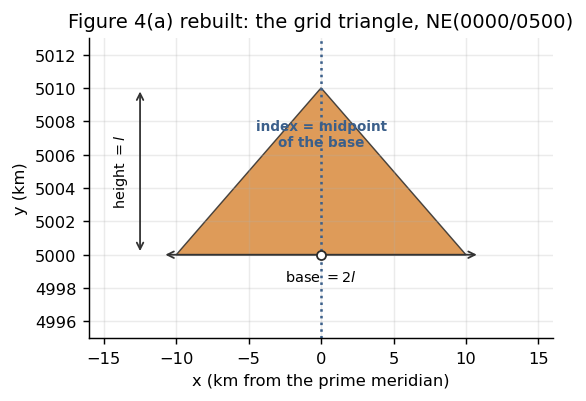
docs/_static/f4/f4_01_grid_triangle.png
The triangle is inherited. A meridian triangle refines into triangles at every resolution, because the indexing does not create separate western cells along that boundary — they are part of the hierarchical subdivision of the adjacent eastern cells. That is also why a western cell with an X index of zero does not exist at all: Cell Validity & Existence.
Trapezoid — the absorbing edge
Where the lattice meets the domain border, the outer cell absorbs the remainder. Its outer side becomes a chord of the border curve, and it is the one family that does not carry the nominal area:
abs_cell = "SE(1930/0196)"
(boundary.cell_shape(abs_cell), boundary.absorbs_border(abs_cell),
 itacart.is_equal_area_cell(abs_cell))
('trapezoid', True, False)
The trapezoid is not inherited. Unlike the triangle, a trapezoid’s children are not all trapezoids, and their count is not the refinement ratio — this cell holds three children where the rule says four. It is also why a child of an absorbing cell reaches past its parent’s ring, which is stated in full at Lexical Ancestry vs Physical Refinement.
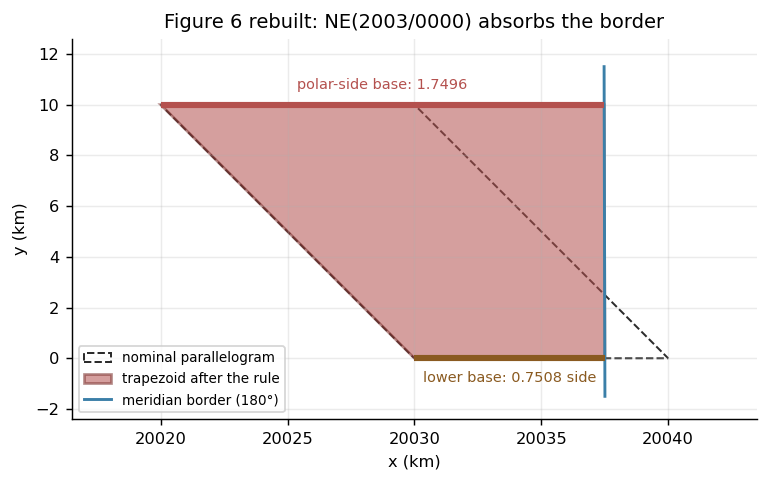
docs/_static/f4/f4_08_trapezoid_absorption.png
The poles
At high latitude the lattice runs out. The last row of the grid is very nearly empty — at resolution 1 it holds six cells in the whole world: four absorbers, one per quadrant in the last existing column, and two prime-meridian triangles, which exist in the eastern quadrants only because the western quadrants have no meridian column.
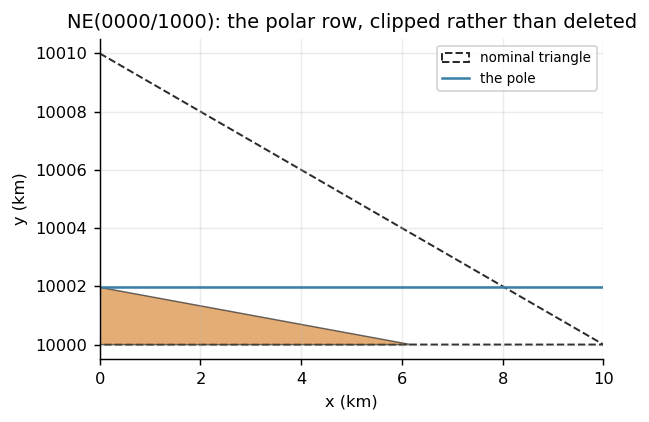
docs/_static/f4/f4_13_polar_row.png
A polar cell is still named a triangle by cell_shape, and it still absorbs
the border — which is exactly why the guard everywhere in this documentation is
is_equal_area_cell and never shape != "trapezoid".
The rule to carry away
Ask cell_shape when you care about vertices. Ask is_equal_area_cell when
you care about area. They answer different questions and the answers do not
line up.