GeometryBlob
The form to use when a geometry must be identified rather than merely covered. It carries ordered vertices, ring topology, the edge model, the densification parameters and the OGC type — everything that makes two encodings of the same parcel the same thing.
from itacart import serialization, geometry
from shapely.geometry import Polygon

parcel = Polygon([(-46.6329, -23.5509), (-46.6327, -23.5509),
                  (-46.6327, -23.5507), (-46.6329, -23.5507)])
ring = geometry.vertex_to_cell(parcel, resolution=13)
blob = serialization.encode_geometry([ring], geometry_type="POLYGON")
len(blob), serialization.read_geometry_type(blob)
(34, 'POLYGON')
read_geometry_type answers from the nine-byte header without decoding the
body — useful when you are routing blobs rather than reading them.
What the header declares
profile = serialization.decode_geometry(blob)
{k: profile[k] for k in profile if k != "rings"}
{'canonical_profile': 'MIN_LEX_CYCLIC_ROTATION',
 'edge_model': 'WGS84_GEODESIC',
 'densification_model': 'ORTHODROMIC_VINCENTY',
 'resolution_mode': 'UNIFORM',
 'max_segment_m': 1000,
 'resolution': 13,
 'geometry_type': 'POLYGON'}
Every one of those fields is a decision that a consumer cannot recover from coordinates alone. Edge Semantics is the page for the first two.
Orientation is meaning; rotation is spelling
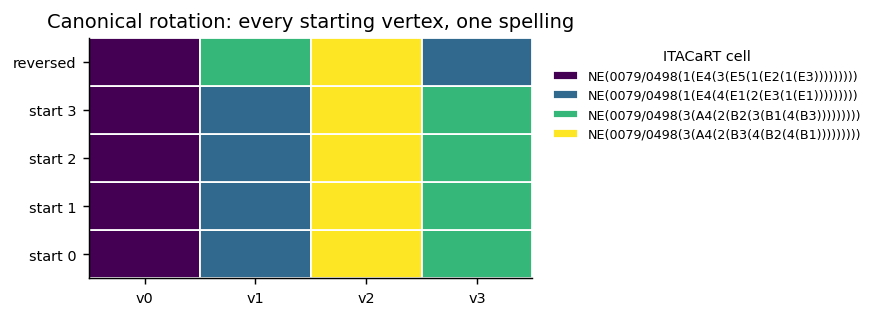
Ring orientation is significant and is preserved exactly. Canonicalisation may rotate a closed ring to its least starting vertex — it never reverses one, because rotating is a change of spelling and reversing is a change of meaning.
docs/_static/f7/f7_10_canonical_rotation.png
Which ring is the exterior and which are holes is carried by part order: the first ring of a component is its exterior. That is a structural convention rather than something inferred from winding, and it is why the format can hold multi-part geometries without ambiguity.
Identity, and hashing
serialization.geometry_hash(blob)[:12]
b'(\xd3\xbf\xc5\x0eaB\xf8@\t?\x1c'
The hash is taken over the canonical form, which is what makes it an identity rather than a checksum of one particular spelling. Two records of the same parcel, encoded independently, hash the same — and that is the property a registry or a ledger needs.
Canonical Geometry is the cadastral treatment of the same idea.
The bridge to TreeBlob, and why it is one-way
tree = serialization.geometry_to_tree(blob)
len(blob), len(tree)
(34, 40)
geometry_to_tree derives the TreeBlob of a GeometryBlob’s vertex set. The
derivation is one-way by construction: order, ring topology, edge model and
geometry type all vanish, so distinct geometries over the same vertices yield
one TreeBlob.
Coverage survives; identity does not. This is a property the format is built on, and the package states it as a test that asserts the loss rather than one that regrets it.
Note that the derived blob is not necessarily smaller — above it is larger. The two forms differ in what they can answer, not in how much they cost.
So: keep the GeometryBlob if you will ever need to say which geometry. Derive the TreeBlob when you only need to say where.
The wire format is specified byte by byte in GeometryBlob binary encoding.