Effective vs Nominal Geometry
Two numbers describe a cell’s area. The nominal area is what the specification assigns to the resolution. The effective area is what the cell’s own boundary encloses. They agree almost everywhere, and the places they do not are the reason both exist.
import itacart
cell = "SE(1400/0374)"
itacart.nominal_cell_area(1), itacart.effective_cell_area(cell)
(100000000.0, 100000000.0)
Identical, for an interior cell. Note the signatures differ in a way that says what each one is: nominal takes a resolution, because under the guarantee the cell cannot matter; effective takes a cell, because it is a measurement of that cell.
Where they part
absorber = "SE(1930/0196)"
itacart.effective_cell_area(absorber), itacart.nominal_cell_area(1)
(50436934.696193784, 100000000.0)
Roughly half. This cell absorbs the domain border: its longer base is clipped at the boundary line, so the area is computed from the actual vertices rather than assumed from the table.
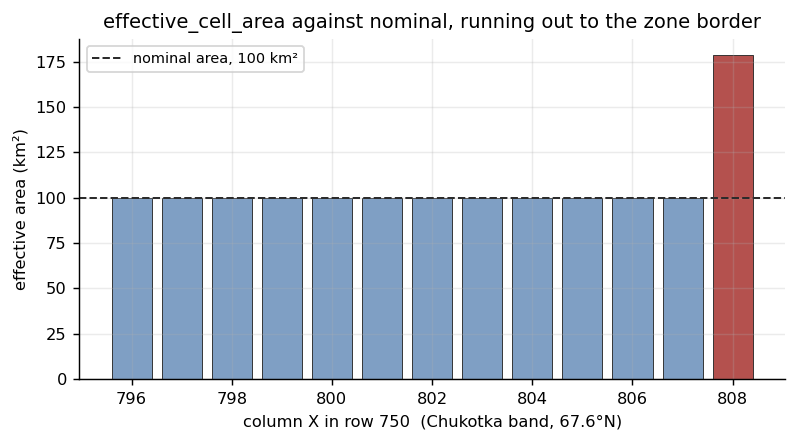
docs/_static/f4/f4_06_effective_vs_nominal_area.png
For clipped and other special boundary cells, the effective area is the area of the geometry that actually exists, not the nominal area of a regular cell at the same resolution.
This distinction matters for geometric correctness and for any computation that relies on the actual cell footprint. Returning the nominal area would overstate the area of these cells, in some cases substantially.
In ITACaRT, however, the affected cells occur in polar or oceanic boundary regions rather than in the cadastral areas for which the system is intended. The issue is therefore one of geometric and API correctness, not a practical parcel-area or taxation error.
Asking the construction, not the shape name
The natural guard looks like shape != "trapezoid". It is wrong.
from itacart import boundary
[(c, boundary.cell_shape(c), boundary.absorbs_border(c), itacart.is_equal_area_cell(c))
 for c in ("SE(1400/0374)", "NE(0000/0500)", "SE(1930/0196)")]
[('SE(1400/0374)', 'parallelogram', False, True),
 ('NE(0000/0500)', 'triangle', False, True),
 ('SE(1930/0196)', 'trapezoid', True, False)]
A prime-meridian triangle is not a parallelogram and still carries the nominal area — a triangle has the same base-and-height behaviour, so the area survives the change of shape. Meanwhile a polar cell is still named a triangle and still absorbs the border, so it does not carry the nominal area.
Shape and area-honesty are two different questions. is_equal_area_cell asks
the second one directly, and it is the guard to use:
def parcel_area(cells, resolution):
    """Nominal where the guarantee holds, measured where it does not."""
    return sum(itacart.nominal_cell_area(resolution) if itacart.is_equal_area_cell(c)
               else itacart.effective_cell_area(c)
               for c in cells)

parcel_area(["SE(1400/0374)", "SE(1930/0196)"], 1)
150436934.69619378
Why the package refuses to choose for you
It would be easy for nominal_cell_area to quietly return the effective
area when the two diverge. ITACaRT deliberately keeps the quantities separate:
the nominal area describes the regular cell implied by the resolution, while
the effective area describes the geometry that actually exists.
Silently substituting one for the other would hide an important distinction in the grid model and could make downstream geometric calculations appear consistent while using the wrong quantity.
For that reason the two functions remain separate, and is_equal_area_cell
lets the caller determine whether the nominal and effective interpretations
coincide for a particular cell. In ordinary cadastral regions they normally
do; the distinction becomes relevant mainly in the special polar and boundary
families where the effective geometry departs from the regular cell.